Breathlessness: Information for clinicians

Breathlessness is a very common distressing symptom in malignant and non-malignant disease. Up to 70% of patients with cancer experience breathlessness in the 6 weeks prior to death, and this may be greater in lung cancer patients because of co-existent COPD and right sided heart failure.

It is a frightening symptom for the patient and for those caring for them. There are specific resources for carers here.

Consider reversibility if appropriate

Treatment options

Non–pharmacological interventions
  • Keep room cool and open windows
  • A hand-held fan blowing towards the face
  • Pursed-lip breathing - inhale through nose with mouth closed, then exhale slowly through pursed lips for 4 to 6 seconds.
  • Sitting upright and lean forward with arms bracing a chair or knees
  • Visualisation and complementary therapy
  • Nutritional advice e.g. small frequent meals, easily chewed
  • Anxiety management
  • Social interaction eg Breatheasy groups
Opioids
  • Relieve the sensation of breathlessness - there is much evidence of efficacy and safety in doses of less than 20mg per day
  • Start low and go slow e.g. immediate release oral Morphine (e.g. Oramorph®) 2.5mg–5mg P.R.N., then regularly 4-6 hourly if beneficial
  • Even lower doses may help if elderly or frail e.g. 1mg to 2mg oral Morphine
  • Long-acting opioids can be very effective and are safe e.g. Morphine Modified Release Tablets 5mg bd
Benzodiazepines
  • Useful for those patients with anxiety/panic associated with episodes of breathlessness
  • Less evidence for efficacy than opioids in relieving breathlessness
  • e.g. Lorazepam (1mg blue tablet – Genus or Teva brand) 0.5mg sublingual 4–6 hourly P.R.N. 
For patients already on opioids 

Lower opioid dose needed than breakthrough analgesic dose is often sufficient for breathlessness, e.g. 25-50% of the current PRN analgesic dose.

Oxygen

Limited value if oxygen saturation is already >92%. However some patients find the work of breathing is eased by Oxygen even if if oxygen saturation is good.

Breathlessness in the last days
  • Continue non-pharmacological treatments
  • Morphine 2.5 mg to 5 mg and Midazolam 2.5 mg -5mg subcut P.R.N. for repiratory distress (a syringe pump may help if several injections are needed)
  • Morphine 10 mg over 24 hours via a syringe pump, increasing stepwise to Morphine 30 mg over 24 hours as needed (start with 5mg if very frail)
  • Midazolam 10 mg over 24 hours via the syringe driver, increasing stepwise to Midazolam 30 mg over 24 hours as required (start with 5mg if very frail)
  • Consider 20-40mg furosemide subcut or an infusion as pulmonary oedema may be contributing
  • Consider treating retained secretions (death rattle) 

Key Points

  • Do contact the local specialist palliative care team for more specific advice
  • Lower starting doses in frail elderly and those with renal failure
  • Non-drug methods to relieve breathlessness are crucial
  • Identify and treat reversible causes of breathlessness 
  • Consider an opioid and benzodiazepine combination for patients at the end of life
  • Sedation and opioid use should not be withheld because of a fear of causing respiratory depression. The intention is to relieve respiratory distress, not to hasten death

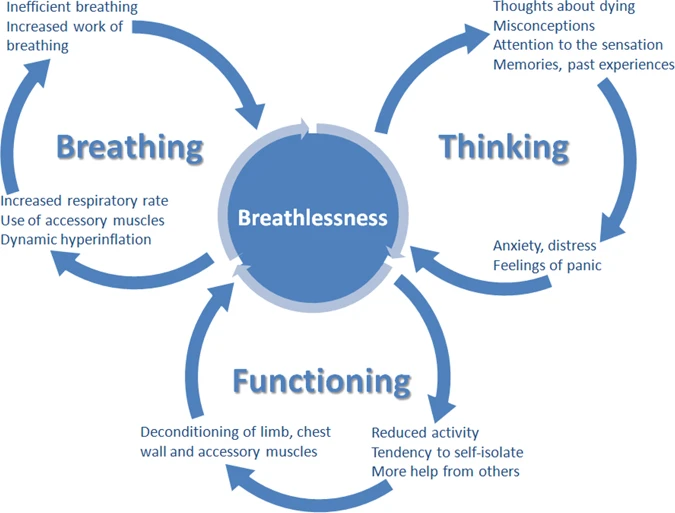
Chronic breathlessness syndrome is breathlessness that persists despite optimal treatment and can be managed with the Breathing, Thinking, Functioning holistic approach:
 

mceu-30882676011775724176361.webp


Recommended Resources

Scottish Palliative Care Guidelines - Breathlessness

Published 1st February 2026

West Midlands Palliative Care - Breathlessness in the last days

Published 1st July 2024

Primary Care Respiratory Medicine: Cutting through complexity: the Breathing, Thinking, Functioning clinical model

Published 10th May 2021

Share

Related Services

Palliative care teams

24 hour Advice Line Pembridge Hospice
Close

24 hour Advice Line Pembridge Hospice

T. 0208 102 5000

W. https://www.pembridgehospice.org/

Pembridge Hospice provides palliative care services and advice to the residents of Brent, Central London, West London and Hammermith and Fulham.

This is a 24 hour, 7 days a week telephone advice line.

Referral form for clinician use only.


Community Specialist Palliative Care Referral Form V4.2 (DOCX)
Community Palliative Care Team - based at St. John's Hospice
Close

Community Palliative Care Team - based at St. John's Hospice

T. 020 7806 4040

St. John's Hospice provides advice and visiting palliative care patients for some parts of Central London.

Referrals can be made Monday to Sunday 9.00am to 5.00pm.

Referral form for clinician use only.

Community Specialist Palliative Care Referral Form V4.2 (DOCX)
Community Palliative Care Team (South) - Royal Trinity
Close

Community Palliative Care Team (South) - Royal Trinity

T. 020 7787 1062

Royal Trinity Hospice (South) provides advice and visiting palliative care patients of Hammersmith and Fulham, Central London and West London.

They can be contacted 8am -8pm  7 days a week.

Referral form for clinician use only.

Community Specialist Palliative Care Referral Form V4.2 (DOCX)
Pembridge Community Palliative Care Team (North)
Close

Pembridge Community Palliative Care Team (North)

T. 0208 102 5383 / 0208 102 5000 (out of hours)

Pembridge Community Palliative Nurse Team (North) provides advice and visiting palliative care patients of Hammersmith and Fulham, Central London and West London.

They can be contacted Monday to Friday 8.30am to 5.00pm.

Referral form for clinician use only.

Community Specialist Palliative Care Referral Form V4.2 (DOCX)
Royal Trinity Hospice
Close

Royal Trinity Hospice

T. 0207 787 1062

W. https://www.royaltrinityhospice.london/

Royal Trinity Hospice provides palliative care services to the residents of Hammersmith and Fulham, Central London and West London.

There is a 24 hour, 7 days a week clinical advice line and OOH access to the on-call consultant.

Referral form for clinician use only.

Community Specialist Palliative Care Referral Form V4.2 (DOCX)
St John's Hospice at Home
Close

St John's Hospice at Home

T. 020 7806 4027

St. John's Hospice provides palliative care services to the residents of Brent and Westminster.

Telephone response will be received within 2 hours.

Inclusions are: Terminal care last 2 weeks of life, 24 hour, admission avoidance, facilitated discharge and respite care escorting a patient.

Referral form for clinician use only.

Community Specialist Palliative Care Referral Form V4.2 (DOCX)
St John's Hospice Inpatient unit
Close

St John's Hospice Inpatient unit

T. 020 7806 4040 / 07725 258767

W. https://www.stjohnshospice.org.uk/our-care/inpatient-care

St. John's Hospice provides inpatient palliative care services to the residents of Brent, Central London and West London.

This is an inpatient unit with 18 beds

Please contact for admissions for advice and Community Specialist Palliative Care.

The office hours are Monday to Friday 8.30am to 4.30pm. Referrals received in the morning are triaged the same afternoon, and those received in the afternoon are triaged the following working day.

If urgent, please follow up the referral by calling us on 020 7806 4040. Out of hours, urgent referrals will be discussed with the consultant on call.

Referral form for clinician use only.

Community Specialist Palliative Care Referral Form V4.2 (DOCX)

Pharmacies

Bayswater Pharmacy
Close

A community pharmacy which stocks common palliative medicines to support people being cared for at home

Address: 39-41 Porchester Road, Bayswater, W2 5DP

Opening hours: Monday to Friday 9.00am to 7.00pm. Saturday 9.00am to 6.00pm. Sunday 11.00am to 5.00pm

Clinichem
Close

Clinichem

T. 020 78281222

A community pharmacy which stocks common palliative medicines to support people being cared for at home

Address: 29 Upper Tachbrook Street, SW1V 1SN

Opening hours: Monday to Friday 9.00am to 6.00pm

Lymphoedema services

British Lymphology Society
Close

British Lymphology Society

W. https://www.thebls.com/directory/london

The British Lymphology Society provides a directory of Lymphoedema treatment services.

Use the website address above to find your local services.

LymphConnect
Close

LymphConnect is an online platform developed to help manage lymphoedema or lipoedema, understand more about the condition, share experiences and get support and advice.


St John's Hospice Lymphoedema Care
Close

This clinic is for patients suffering from lymphoedema in any part of their body as a result of cancer treatment or chronic conditions.

The lymphoedema care provided is free to NHS patients registered with a GP within our catchment area. The NHS service is provided within St John and St Elizabeth Hospital under the hospice or at Charing Cross Hospital.

Cancer services

Marie Curie
Close

Marie Curie

T. 0800 090 2309

W. https://www.mariecurie.org.uk/

Marie Curie provide support for patients and carers through terminal illness.

Find information and support through the telephone helpline and online chat via their website.

Other services include Marie Curie nurses, Hospice care, helper and companion services.

St John's Hospice Lymphoedema Care
Close

This clinic is for patients suffering from lymphoedema in any part of their body as a result of cancer treatment or chronic conditions.

The lymphoedema care provided is free to NHS patients registered with a GP within our catchment area. The NHS service is provided within St John and St Elizabeth Hospital under the hospice or at Charing Cross Hospital.

Young lives vs Cancer
Close

Young lives vs Cancer

W. https://www.younglivesvscancer.org.uk/

Young lives vs Cancer support young people under 25 with cancer, and their families, to get the help they need during their cancer treatment and beyond, including bereaved families living with emotional distress. 

Overnight/weekend services

St John's Hospice at Home
Close

St John's Hospice at Home

T. 020 7806 4027

St. John's Hospice provides palliative care services to the residents of Brent and Westminster.

Telephone response will be received within 2 hours.

Inclusions are: Terminal care last 2 weeks of life, 24 hour, admission avoidance, facilitated discharge and respite care escorting a patient.

Referral form for clinician use only.

Community Specialist Palliative Care Referral Form V4.2 (DOCX)

Related Articles

2nd April 2026

Managing breathlessness at home: Information for patients and carers

Feedback